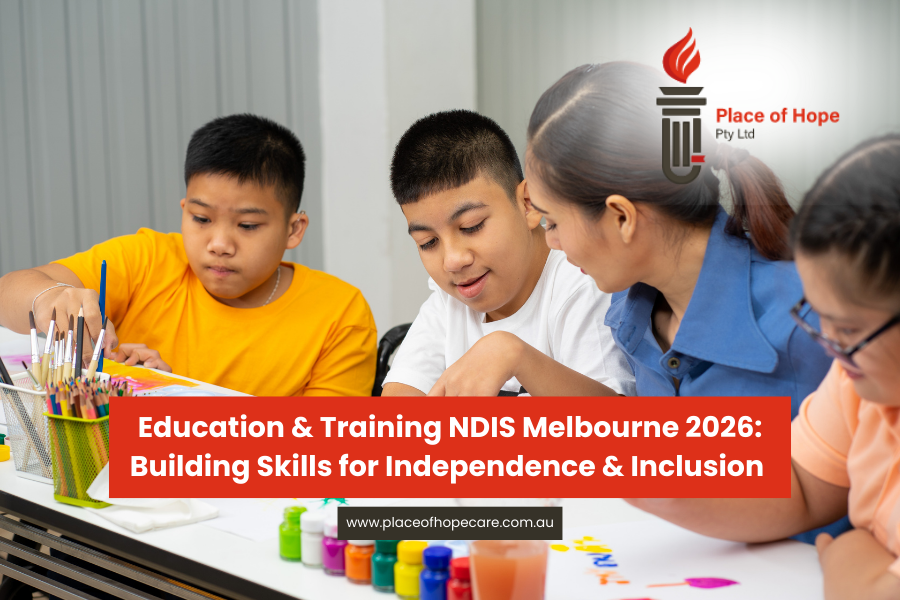
Navigating the NDIS can often feel complex and challenging. While you may have a plan in place, clear goals, and a vision for your future, turning those aspirations into meaningful everyday outcomes requires the right support. Finding services that align with your needs and help translate your NDIS plan into practical, real-life progress is where the journey toward independence truly begins.
In 2026, the conversation around the NDIS in Victoria shifted from basic care to empowerment. It’s now about building skill awareness and independence, whether that means using public transport, managing money, or gaining the confidence to join community activities through the right education training of NDIS Melbourne programs.
At Place of Hope, we don’t believe that a disability should ever put a ceiling on your ambition. In this comprehensive guide, we’re going to look at how training can foster real personal growth NDIS Victoria-wide, and how you can build the independence knowledge programs you need to live life on your terms.
Why “Capacity Building” is a Big Deal
A lot of people think NDIS support is just about having someone do things for them. But there’s a much more powerful part of the scheme called capacity building.
Just imagine it is like this: capacity building is the how-to-manual to your life. It is the difference between one having someone cook a meal every day and knowing how to make something healthy on their own. With training investment, you are investing in yourself. You are developing the self-advocacy ability to ask the world what you require and better still the confidence to go and get it.
It is the ability to change the dial that is set at I need help to know how to do this. That change does not only make life easy, but it alters your perception of yourself. It is the contrast between a dependent and independent life.
How to Get Training Included in Your Plan
One of the biggest frustrations we hear is, “I want to learn, but I don’t have the funding.” The trick isn’t just asking for “training”; it’s about how you frame your goals during your plan review.
When you sit down with a Local Area Coordinator (LAC) or your NDIS planner, you need to be clear about why these matters. They are looking for “reasonable and necessary” support. If you want training funded, you need to show them how it helps you meet your long-term goals.
The SMART Approach to Planning
- Be Specific: Instead of saying “I want to learn,” say “I want to do a basic retail training course at my local TAFE.”
- Make it Measurable: “I want to attend a weekly session for six months.”
- Keep it Relevant: Explain why this matters. Does it lead to employment? Does it mean you’ll need fewer hours of support in the long run? That’s the kind of argument that gets heard.
- Be Time-bound: “I aim to complete this certification by the end of my current plan period.”
If you can show how a course helps you rely less on paid support, you’re hitting the nail on the head. For example, if you learn to use a banking app independently, you might need two hours less of support each week. That is a concrete win for both you and the NDIS.
Real Skills for Real Life
“Education and training” sounds a bit formal, right? But for us, it’s all about the practical stuff that makes your life easier. It’s about the skills that let you walk out the door and feel like you belong in the community.
1. Mastering the World Around You (Transport & Tech)
The train and tram network in Melbourne may be a nightmare to someone who is sensory, sensitive, or anxious. Knowing how to find your way into different routes, using your Myki card, how to cope with the unexpected delays and do this on your own is as much enhancement of the freedom as you can get.
On the same note, digital literacy is a requirement in 2026. Whether playing on the NDIS portal or being able to spend time with friends via video calls, it is necessary to know how to navigate a smartphone or personal computer. We are allowing you to cut through the jargon and get to know the tech that actually benefits you.
2. Financial Literacy & Budgeting
Understanding your funding, how to read a budget, how to manage your own spending money, and to know how you are going to fund what you are about to do. It may well be stressful, yet not necessarily. We make it unproblematic and easy to manage systems that will keep your budget on track, not on your head.
3. Social and Community Connections
Being independent does not merely refer to what you are doing within your four walls; it is how you go about in your community. In case you have ever felt like an outsider, social training (such as how to approach a conversation, how to cope with a busy cafe, how to enter a hobby club) can make a big difference in this situation. You are not merely socialising, you are creating a social network that will enhance your life.
The Power of Personal Growth
We often hear from participants that they feel “stuck” in a routine. Personal growth NDIS Victoria initiatives are designed to break that cycle.
It’s about self-discovery. What do you care about it? What are some of the skills that you have always desired to learn but never had an opportunity to do so in the right context?
- Developing Confidence: It is quickest to develop confidence in trying things in a safe and supported environment.
- Peer Connections: The training settings offer an excellent avenue to get to know other people like you who are going through the same path, making the experience of disability slightly less lonesome.
- Emotional Control: Training to deal with stress and overwhelm, which is essential in long-term mental health.
The process of personal development is an internal process that comes out in the outside world. When you feel like you can, you get a little taller. With a community, you are a little safer.
What to Look for in a Provider
When you are browsing to find an employee to work with you in Melbourne, you cannot just find one with a shiny site. Looking for a partner.
- Do they listen? An excellent provider does not apply for the one-size-fits-all course. They are supposed to sit down and negotiate with you on what you really want to accomplish.
- Are they patient? Learning new things is hard. You must have a trainer who makes you feel like celebrating even the small wins rather than someone who wants to go on a checklist with you.
- Is it accessible? Is the training format what your senses are like? Do you feel comfortable in space? You can insist on a set up that can assist you in learning rather than one that causes you to feel tired.
- Are they local? It is significant to know the Melbourne landscape. Someone in the area will be able to tell you the most appropriate places to train your skills and the social organizations that are open.
It’s Okay to Feel Intimidated
Look, let’s be real. It is frightening to learn something new. You may have had some negative experiences with school in the past, or you may fear failing. You may reason, what shall I do in case I cannot do it?
However, the thing is that learning is not a straight line. There are days when it will be difficult and that is alright. It is not to become the perfect one but to become somewhat better than you were yesterday.
Strategies for Your Success:
- Start Small: Do not attempt to make changes in your entire life within a week. Pick one skill. Maybe it is making a sandwich or maybe it is a checkout at the supermarket.
- Celebrate Wins: Did you go to a class, which you were afraid of? That’s a win. Did you ask a question? That’s a win.
- Express Your Fears: Should a style of teaching not be working well with you, inform them! An effective support worker will alter him/herself to fit you. They are present to serve you, and they are unable to repair it unless they know it is broken.
Why Choose Place of Hope?
At Place of Hope, we don’t just tick boxes. We are familiar with the Melbourne community, we have an idea of how the NDIS functions in 2026, and we are truly interested in your development. We do not think of you as a plan number rather than a person.
We have been founded on empathy, integrity, and respect. It is known that all participants are unique, and this is why our approach to education training in NDIS Melbourne is never a one-size-fits-all. We sit at a table with you, examine your plan, and see what the meaning of independence is with you.
Our Commitment to You
- Local Education: we understand Melbourne, and we understand how to get you in touch with what you require.
- Caring Team: Our employees are not only competent, but they are also interested in your success.
- Holistic Support: We do not view your education independently of your housing, health, or social life- we look at the relationship between all of them.
The Future of Inclusion in 2026 and Beyond
As we move through 2026, the emphasis on genuine inclusion is stronger than ever. The NDIS is evolving, and so is the way we approach training. It’s no longer just about meeting basic needs; it’s about lifelong learning.
We’re seeing more participants leverage their funding for:
- Advanced Technology: Using assistive tech to streamline communication and daily management. This includes voice-to-text software, specialized apps for task management, and smart-home integration.
- Vocational Pathways: Exploring pre-employment training that actually leads to work experience. This isn’t just about finding a job but understanding workplace culture and expectations.
- Health and Wellness Education: Understanding how to manage your own health and emotional wellbeing to prevent burnout. This includes nutrition, physical activity, and mindfulness.
- Financial Literacy: Understanding how to manage your NDIS funding, plan for future needs, and maintain a personal budget.
Overcoming the “Plan Plateau”
Sometimes, you might feel like your NDIS plan has hit a plateau. You’ve mastered your current skills, but you don’t know what’s next. This is a common feeling, but it’s actually a great opportunity. It’s the time to look for a new challenge.
Perhaps you’ve mastered independent travel; now it’s time to focus on vocational skills. Maybe you’ve conquered basic cooking; now it’s time to look at healthy meal planning for a long-term, sustainable lifestyle. Never stop asking: “What else can I do?”
Building Your Support Network
Education is also about people. Often, the most important part of a training program isn’t the skill itself, but the connection you make with your trainer and your peers.
When you engage in training, you’re stepping out of isolation. You’re meeting people who share your experiences and, often, your sense of humour. You’re building a support network that extends beyond paid care. That community connection is one of the most powerful aspects of any NDIS-funded activity.
Take the Next Step Toward Independence
The road to independence is built one step at a time. Choosing to focus on your own education and training is one of the bravest, most rewarding steps you can take.
Don’t wait to start reaching your goals. Whether you’re just starting your NDIS journey or you’ve been on this path for years, we’re here to have a yarn about what’s possible.
Ready to get started?
Ready to get started? Visit Place of Hope or call 0452 436 218, let’s build your future together.