In the heart of Victoria’s bustling capital, the landscape of disability support is shifting. As we move through 2026, the conversation has moved away from “care” and toward “capacity.” For many Australians living with a disability, the goal isn’t just to be looked after, it’s to have the agency to live life on their own terms.
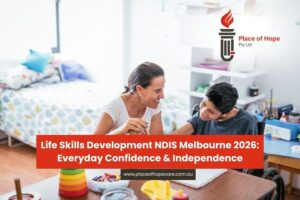
Life skills development NDIS Melbourne is the bridge between where you are now and where you want to be. It’s the difference between having someone cook your dinner and knowing how to whip up a stellar meal yourself. It’s the difference between being driven to an appointment and mastering the PTV network like a pro.
In this exhaustive 2026 guide, we’re going deep. We’ll cover the “why,” the “how,” and the “where” of building independence in Melbourne, ensuring you have the tools to turn your NDIS goals into reality.
The Philosophy of Independence in 2026
For too long, disability support was about “doing” the participant. In 2026, we’ve realised that this often leads to “learnt helplessness.” Real empowerment comes from skill building daily routines that stick to.
The “Dignity of Risk”
One of the core concepts we champion at Place of Hope is the Dignity of Risk. This means acknowledging that learning involves mistakes. You might burn a piece of toast while learning to cook, or you might get on the wrong tram while learning the route to St Kilda.
That’s okay. In fact, it’s necessary. Independence training Victoria-wide is about providing a safe environment where you can take those risks, learn from those hiccups, and come out the other side with more confidence than before.
Moving Beyond “Care”
When we talk about life skills, we’re talking about Capacity Building. This is a specific category in your NDIS plan designed to reduce your reliance on paid support over time. By investing in your skills now, you’re essentially “buying back” your future freedom.
Navigating the Melbourne “Urban Jungle”
Melbourne is a beautiful city, but let’s be real; it can be a logistical nightmare. Between the “Hook Turns” in the CBD and the ever-changing platform numbers at Southern Cross, getting around requires more than just a map; it requires local savvy.
The Myki & PTV Masterclass
In 2026, transport training is a top priority for life skills development in NDIS Melbourne. We don’t just teach you how to tap a card; we teach you:
- Digital Literacy: Managing your Myki via your phone or wearable tech.
- The “Plan B” Mentality: What to do when the Hurstbridge line has “equipment faults” (which, let’s face it, happens).
- Sensory Management: Navigating the rush-hour crush at Flinders Street without feeling overwhelmed.
- Safety Protocols: Identifying “Safe City” taxi ranks and using the emergency buttons on platforms.
Community Hubs as Classrooms
We don’t believe in sitting in an office. Our “classrooms” are the local libraries in Docklands, the community gardens in Collingwood, and the bustling aisles of the Victoria Market. By learning in the real world, the skills become “muscle memory.”
The “Big Three” Pillars of Personal Autonomy
To live independently in Melbourne, you generally need to master three core areas. We break these down into manageable, person-centered life skills modules.
Pillar 1: Household Sovereignty
Your home should be your sanctuary, not a place where you feel lost.
- The Culinary Journey: We start with “No-Cook” meals (sandwiches, salads) and progress to “One-Pot” wonders (slow cookers are a godsend for independence). We teach you knife safety, heat management, and the art of the “clean-as-you-go” workflow.
- Domestic Maintenance: It’s not just about vacuuming. It’s about knowing how to change a lightbulb, how to use a front-loader washing machine without flooding the laundry, and how to spot when a tap needs a new washer.
- Sustainable Living: In 2026, we also focus on waste management—sorting your recycling, FOGO bins, and reducing energy bills.
Pillar 2: Financial Grit & Digital Safety
Australia is almost entirely cashless now. For many, this makes budgeting harder because the money feels “invisible.”
- The Digital Budget: We use visual apps to help participants see where their money is going.
- Scam Defence: This is a huge part of independence training in Victoria. We teach you how to spot a “spoofed” SMS from “Australia Post” and why you should never give your MyGov password to anyone.
- The NDIS Portal: Teaching you how to check your own funding balance, so you’re always in the loop.
Pillar 3: Social & Emotional Intelligence
Independence isn’t just about doing things alone; it’s about interacting with others.
- Assertiveness Training: How to ask for what you need at the GP or the Centrelink office without getting frustrated.
- Friendship & Boundaries: Navigating social media safely and building real-world connections at local Melbourne “Meetup” groups or sports clubs.
- Conflict Resolution: What to do if a housemate leaves the dishes out (the eternal Melbourne struggle).
Why “Person-Centered” is the Only Way Forward
If you’ve spent five minutes in the NDIS world, you’ve heard the term “person-centered.” But at Place of Hope, we treat it as a mandate, not a buzzword.
Tailoring the Task to the Person
If a participant has a goal to work in a café, their life skills development in NDIS Melbourne shouldn’t be about folding laundry. It should be about:
- Learning to follow multi-step instructions (recipes).
- Practicing “Front of House” greetings and social cues.
- Managing time and “clocking in” rituals.
Aligning the skills with the person’s actual passions, the “work” of learning feels like a “win.”
Breaking Down the NDIS Funding
How do you actually get a 2000-word-level deep dive into your plan? You need to know the code.
Capacity Building – Daily Activity
This is the primary bucket for life skills development in NDIS Melbourne.
- Development of Daily Living and Life Skills (09_009_0117_6_3): This is the “gold standard” code for training. It covers the hours spent with a mentor or specialist trainer who is teaching you how to do things for yourself.
- Public Transport Training: Often wrapped into the above, this allows for specific hours dedicated to mastering the PTV.
Core Supports vs. Capacity Building
A common mistake Melburnians make is using all their “Core” funding for someone to “do” things for them. In 2026, the NDIA is looking for “Goal Progression.” If you can show that you used your funding to learn a skill, you are much more likely to maintain or increase your funding in the next plan cycle.
Technology as an Independence Multiplier
In 2026, technology is the “great equaliser.” Independence training in Victoria now includes a heavy focus on “Assistive Tech” (AT).
Smart Home Integration
We help participants set up:
- Voice-Activated Reminders: “Hey Google, remind me to take my meds at 8 AM.”
- Automated Safety: Smart plugs that turn off the iron or the hair straightener automatically after 30 minutes.
- Video Doorbells: So, you can see who is at the door before opening it, a huge boost for personal safety.
Navigation Apps
Beyond just Google Maps, we use apps specifically designed for accessibility that show where the elevators are at Melbourne Central or which tram stops have level-access platforms.
The “Place of Hope” Methodology: A 4-Step Process
We don’t just wing it. Our approach to life skills development NDIS Melbourne follows a proven framework:
1. The Audit
We sit down with you and map out your “Day in the Life.” Where are the bottlenecks? What makes you anxious? What do you wish you could do without calling your Mum or your support worker?
2. The Blueprint
We create a “Skill Roadmap.” We break your big goals (like “Living in my own flat”) into tiny, achievable “Micro-Skills.”
3. The Implementation (The Fun Part)
This is the “boots on the ground” phase. We went out to Melbourne. We go to the shops, cook meals, we ride the trains. We stay by your side until you tell us to back off.
4. The Review & Pivot
Every month, we look at the wins. Did you master the microwave? Great! Let’s move to the oven. Did you handle the bus ride alone? Awesome! Let’s try the train.
Overcoming the Psychological Barriers
Often, the biggest barrier to independence isn’t a physical or cognitive disability—it’s anxiety.
The “What If” Monster
- “What if I get lost?”
- “What if I lose my Myki?”
- “What if I forget the recipe halfway through?”
Our mentors are trained in basic coaching and anxiety-management techniques. We teach “Grounding” exercises for when the Melbourne crowds get too much. We teach you that “getting lost” is just an “unplanned adventure,” and we show you exactly how to get back on track.
Case Studies of Success in Melbourne
Real stories from Melbourne locals who have swapped “being looked after” for “taking the lead.” See how tailored NDIS life skills training is helping Victorians master their daily routines, navigate the PTV, and build the confidence to live independently.
Case Study A: The Northcote Navigator
“Jared” had never used public transport alone due to severe social anxiety. Through six months of life skills development in NDIS Melbourne, Jared went from “Station Tours” (just standing on the platform) to “Short Hops” (one station and back) to eventually commuting to his TAFE course in Preston every single day.
Case Study B: The Kitchen Queen of Werribee
“Sarah” lived in a shared house but relied on frozen meals. We worked with Sarah to develop a “5-Meal Rotation.” By mastering five simple, healthy recipes, Sarah not only improved her health but saved enough money from her grocery budget to buy a new iPad.
Frequently Asked Questions
How is “Life Skills” different from “Personal Care”?
Personal care is someone helping you shower or dress. Life skills is someone teaching you the techniques or using assistive tools so you can eventually shower or dress yourself.
Does NDIS fund cooking ingredients?
Generally, no. The NDIS funds support and the training. You still pay for your own “board and lodging” (food, rent, etc.). However, the training on how to shop and cook is fully covered.
Can I do life skills training in a group?
Yes! Melbourne has some fantastic community-based group programs. These are great for social skills, but for things like “Home Management,” one-on-one training in your own kitchen is usually more effective.
Choosing the Right Melbourne Partner
There are hundreds of providers in Victoria. Why choose Place of Hope?
Because we live and breathe in this city. We aren’t a national “megacorp” where you’re just a number on a spreadsheet. We are local, we are hands-on, and we believe that the NDIS should be a springboard, not a safety net.
We specialise in person-centered life skills that actually lead to change. We don’t want to be your support provider forever; we want to be the team that helped you outgrow the need for support.
Conclusion: Step Into Your Future Today
The journey to independence doesn’t start with a massive leap. It starts with a single choice to do one thing differently today.
Whether you’re in the Western Suburbs, the leafy East, or the heart of the CBD, life skills development NDIS Melbourne is your ticket to a bigger, bolder life. 2026 is the year you stop asking “Can I?” and start saying “I can.”
Ready to start your roadmap to independence?
Contact Place of Hope today. Let’s have a coffee, look at your NDIS plan, and start building the life you deserve. No jargon, no fluff, just real skills for the real world.